
Lot n° 49
Estimation :
3000 - 5000
EUR
S'inscrire sur drouot.com
Laisser un ordre
Votre montant
EUR
Enchérir par téléphone
Enchérir par téléphone
Votre montant
EUR
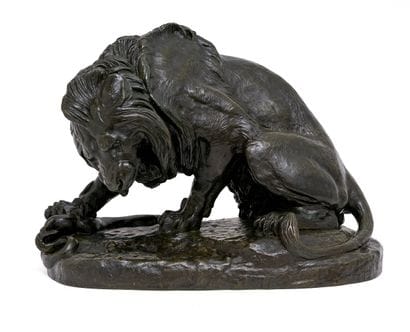
Antoine Louis Barye (1795–1875) - Lot 49
Antoine Louis Barye (1795–1875)
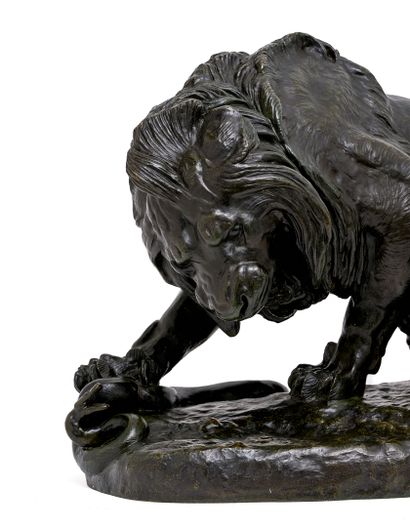
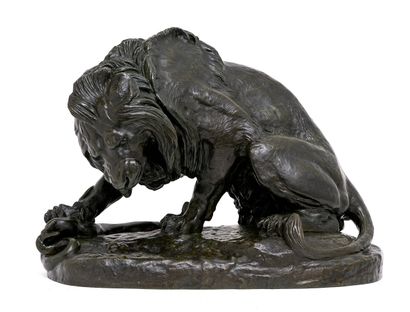
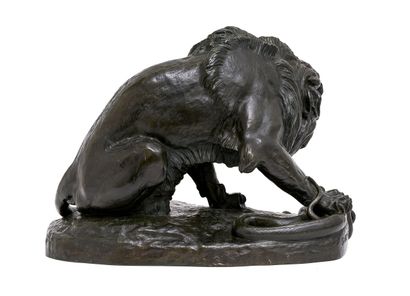
Lion with a Snake, known as the Lion of the Tuileries
Model created in 1833
Bronze with a brown-green patina
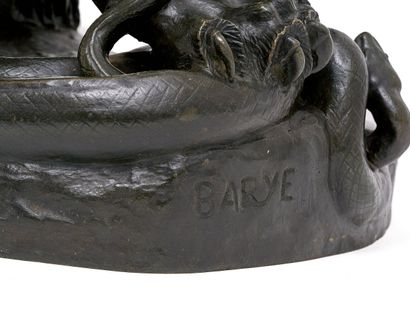
Signed “BARYE” on the front beneath the right paw
Dimensions: 37 x 46.5 x 26.5 cm
Provenance: former collection of the painter Charles Bertier, by descent
Related works:
- Antoine Louis Barye, Lion with a Snake, plaster group, 1832, signed and dated “BARYE / 1832” on the plinth of the terrace, H. 135 x 178.5 x 101 cm, Lyon, Museum of Fine Arts, inv. no. H 2457
- Antoine Louis Barye, Lion with a Snake (Lion of the Tuileries), 1832, bronze, signed “BARYE / 1832” on the front of the terrace, bears the foundry’s stamp “AD” near the lion’s tail, bears the foundry’s mark “FONDU PAR HONORÉ GONON / AND HIS TWO SONS / 1835” on the reverse, H. 135 x W. 178 x D. 96 cm, Paris, Louvre Museum, inv. no. RF 1516.
Related literature:
-Michel Poletti, Alain Richarme, *Barye: The Catalog Raisonné of Sculptures*, Paris, Gallimard, 2000; model listed under no. A 51, p. 174.
Buoyed by the success of the 1831 Paris Salon, Antoine Louis Barye (1796–1875) lived up to the expectations raised at the following exhibition by presenting an impressive plaster cast depicting the Lion and the Serpent. While this type of scene had already been depicted by painters, it was unprecedented for a sculptor. The work is striking both for the violence of its subject and for its virtuosity and realism. This naturalistic approach coincided with the arrival of five African lions and eight lionesses at the Museum’s Menagerie following France’s capture of Algiers on November 4, 1830. A political interpretation of the work has also been proposed, identifying the lion as a symbol of the new July Monarchy—born under the auspices of this zodiac sign—which crushed attempts at revolt in 1830.
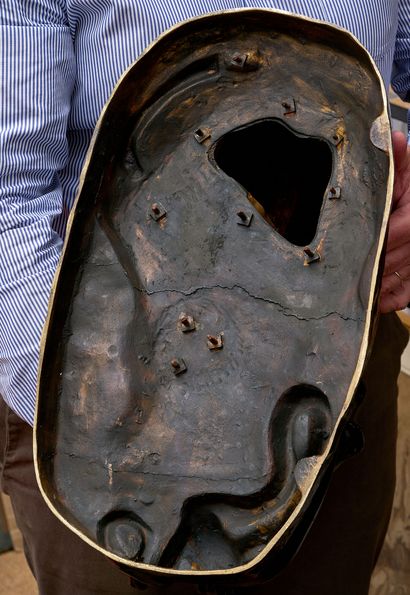
*The Lion and the Snake* occupies a unique place in the sculptor’s career, as its success led the king to commission a marble version, which was ultimately abandoned in favor of a bronze version intended to be installed in front of the Tuileries Palace in 1836. Our rare proof is a reduction slightly less than one-third the size of the bronze copy in the Louvre, cast by Honoré Gonon in 1835. It faithfully reproduces all the details of the plaster model from the 1833 Salon, now housed at the Musée des Beaux-Arts in Lyon. At the auction following Barye’s death in 1876, Hector Brame purchased this version—which is distinguished by its naturalistic terrace—with the intention of producing a posthumous half-size edition (H. 58 cm). There is no formal record of a cast in our size in the literature on the Lion of the Tuileries. At most, it can be noted that Barye’s studio cast a few rare examples between 1857 and 1875, without specifying their size. It should be noted that at the 1855 World’s Fair, the sculptor presented a single proof described as: “The Lion of the Tuileries, in foreshortening.” Our version bears a distinctive stamp depicting a star.
Mes ordres d'achat
Informations sur la vente
Conditions de vente
Retourner au catalogue